


The short answer
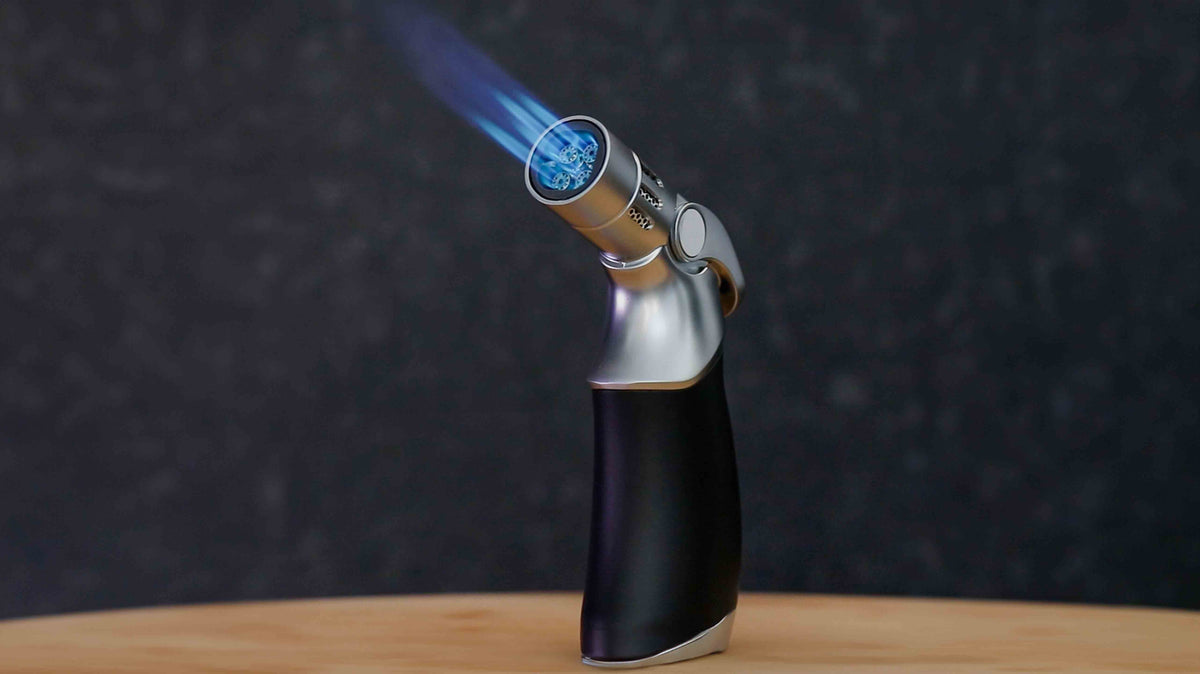
If your lighter stops working, nine times out of ten it isn't actually broken. It's out of gas, the lock is on, the flame is set to its lowest, or the wrong type of gas has been used.
Check these four things below. If you still can't fix it, it's almost always down to the gas: a jet flame needs butane under high pressure, 45 PSI, which you'll find in lighter gas. Universal lighter gas from the supermarket has too little pressure and gives a weak flame that keeps going out.
Check these four things
Nine times out of ten, this is the cause, not a broken lighter.
Is the lock on?
Many jet flame lighters have a slide or button that blocks ignition. It's there to stop the lighter going off in your pocket. Slide it back to the open position and try again. This is by far the most common cause.
Is the gas on the lowest setting?
Turn the flame dial to the middle. On the lowest setting, too little gas escapes to ignite, which can look like an empty lighter. We recommend the middle setting for all our models: too low gives a weak flame, too high wastes gas unnecessarily.
Is the gas turned on?
A full seven-gram tank is good for around eighty to one hundred and twenty ignitions. Refill as soon as the flame gets weaker, not once nothing comes out at all. You'll find the exact steps at refilling a lighter.
Is it too cold?
Butane doesn't evaporate well below freezing point. If your lighter doesn't work outside but does indoors, that's not a fault, just physics. Hold it in your hand or inside pocket for a moment. The same applies right after refilling: fresh gas is ice-cold and needs a few minutes to warm up.
Gas at a glance
for jet flame, torch and gas burner lighters · clean, powerful flame
pressure too low · weak or uneven flame
7 grams · 80 to 120 ignitions
middle setting · too low gives a weak flame, too high wastes gas unnecessarily
What you need
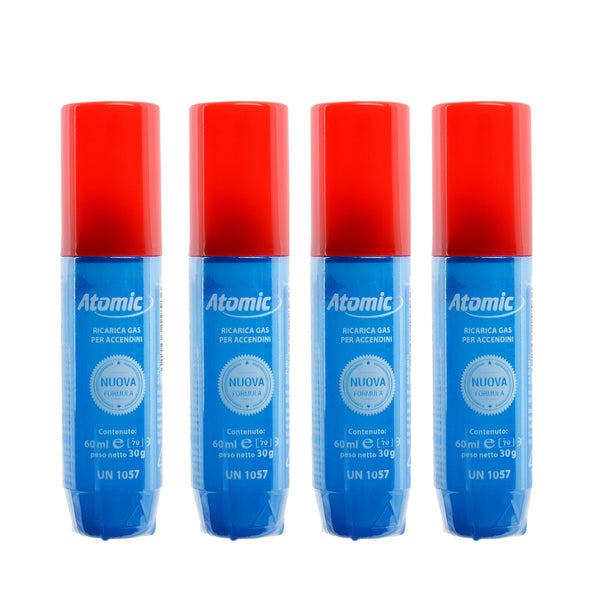
In most cases, one can of gas will do. Choose 45 PSI butane: it's the only gas that keeps a jet flame burning cleanly.
The Atomic Lighter Gas (400 ml) fits almost all our models. One can is good for forty to fifty refills, so it'll last you years.
If you refill often, or own several lighters, the 4x Atomic Lighter Gas (400 ml) for 19,95 euro is the most cost-effective option: four cans at once, and you're sorted for a while.
Heading out? The 4x Atomic Pocket Lighter Gas (60 ml) is handier: four small cans that fit in a coat pocket.
It is topped up and it still does not work
There was still air in it
Filling onto a half full tank does not work: the air inside will not let the gas in. Hold the lighter upright and press the filling valve in with a small flat screwdriver until the hissing stops. Only then top it up.
There is dirt in the nozzle
A lighter that sits loose in a trouser pocket or bag fills with fluff. At the beach it is sand. As soon as something gets into the opening, it burns unevenly or not at all. Blow the nozzle clean with compressed air and try again.
It was the wrong gas
If you put universal lighter gas in it, it keeps burning weakly even after a new filling. Bleed it completely, fill with butane of 45 PSI and give it a few minutes. Usually that is enough.
No more patience for topping up
Fair enough. A lighter without gas exists: a plasma lighter makes an electric arc and charges with a cable. What that can and cannot do you can read in the rise of the plasma lighters.
When is it actually empty
Sometimes it really is the end. If the gas audibly escapes past the valve as soon as you fill, the seal is worn and you will not get it tight again.
The same goes if the spark wheel or the piezo element no longer gives a spark while you do hear the gas flowing. Those parts cannot be replaced separately.
A refillable lighter lasts years in normal use, and that is exactly why it costs more than a disposable model.
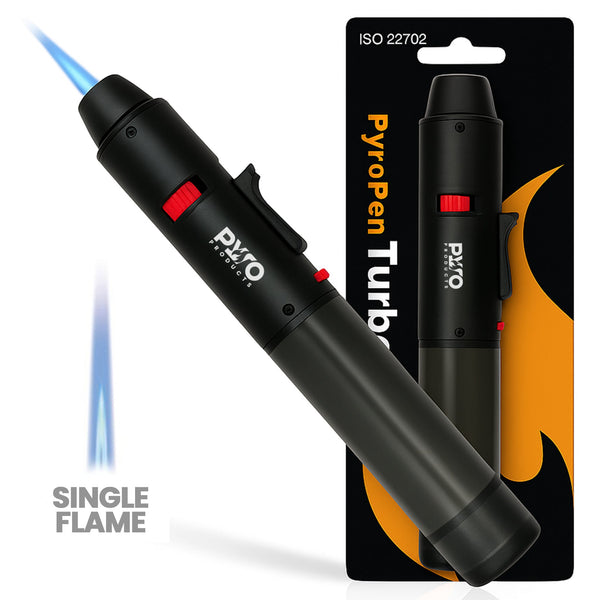
If yours really is at the end, the PyroPen Turbo is the most chosen replacement: refillable, long enough to keep your distance and cheap enough to keep two in the house. Otherwise have a look at refillable lighters or at the whole range.
By the way, do not simply throw an old lighter in with the household waste. There is always some gas left in it, even if it no longer ignites. At most recycling centres it can go with the small chemical waste.
Frequently asked questions
Usually because it is still too cold. Fresh butane is ice cold and expands; give it two to five minutes at room temperature. If it still does not work, there was air in the tank or the wrong gas was used.
Butane under high pressure, 45 PSI. Universal lighter gas has too little pressure for a jet flame and gives a weak or irregular flame. Which can suits your model is shown at lighter gas.
About eighty to a hundred and twenty times on a tank of seven grams, depending on how long you hold the flame. Top up as soon as the flame weakens; waiting until it is completely empty only makes filling harder.
Then it is the temperature. Butane evaporates poorly below freezing, so in the cold too little gas comes out. Hold it in your hand or inside pocket for a moment before use. Nothing is wrong with it.
Bleeding, blowing clean and refilling you can do yourself. If the valve leaks or the ignition no longer sparks, that is the end: those parts cannot be replaced separately. Filling step by step is explained at refilling a lighter.
In short
Sometimes it really is the end. If gas audibly escapes past the valve as soon as you refill, the seal is worn out and you won't get it closed again.
The same goes if the spark wheel or piezo element no longer sparks while you can still hear the gas flowing. Those parts can't be replaced separately.
A refillable lighter lasts for years with normal use, which is exactly why it costs more than a disposable model.
If yours has truly reached the end, the PyroPen Turbo is the most popular replacement: refillable, long enough to keep your distance, and affordable enough to keep two at home. Or take a look at refillable lighters or the full range.
Don't just toss an old lighter in with the general waste, by the way. There's always a bit of gas left inside, even if it no longer ignites. Most recycling centres accept it as small chemical waste.
Related articles
 Lighters
Which lighter is easiest for older people or arthritis?
 Lighters
Jet flame lighter or soft flame: what is the difference?
 Lighters
Can you take a lighter on a plane?
More articles like this?
New tips, product comparisons and exclusive offers straight to your inbox. Plus 10% off your first order.