


The short answer
Yes, you're allowed to take one lighter on the plane, but only if you carry it on your body. So in your trouser or jacket pocket, not in your hand luggage and definitely not in your checked baggage. That's the line held by Dutch and most European airports.
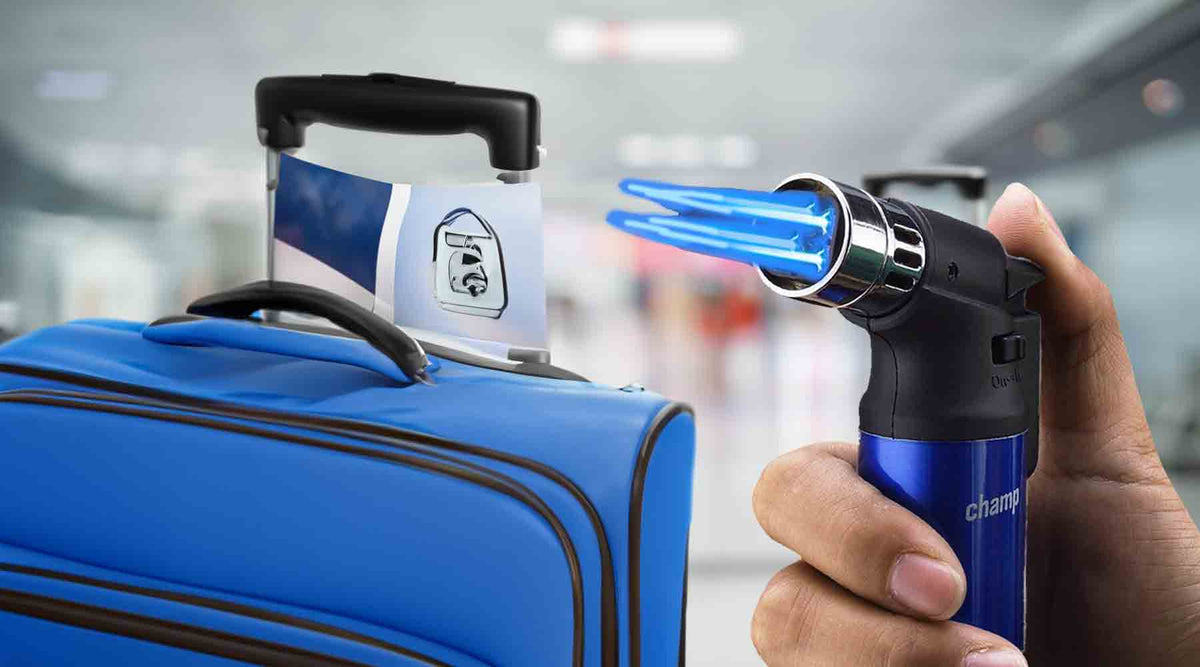
There's one important exception, and it affects almost everyone who buys from us: turbo and jet lighters, also known as blue flame, are usually refused at security. Almost the entire lighters collection consists of jet models. So leave those at home and buy a simple disposable lighter at your destination. If you do bring one, make it a single ordinary flame lighter, carried on your body.
Lighter on a plane: here are the rules
One lighter per person, on your body
The international rule for dangerous goods in aviation allows one small lighter per passenger, and you must carry it on you. Not in a bag, not in a toiletry bag, but literally in your pocket.
The idea behind this is that cabin crew can intervene immediately if there's a problem. A lighter in an overhead locker or in the hold goes unnoticed.
Why not in your checked baggage
Pressure and temperature can fluctuate significantly in the hold. A lighter with pressurised liquid gas doesn't belong among suitcases sliding against each other.
If a lighter is found when your checked baggage is scanned, your suitcase gets set aside and in the worst case you'll have to open it yourself. That costs time you don't have at an airport.
What counts as an ordinary lighter
An ordinary lighter is a small model with a soft yellow flame, like a standard disposable lighter. Anything that produces a concentrated blue jet flame doesn't count. That distinction is the whole story in this article.
Which lighters definitely aren't allowed
Turbo and jet lighters
A jet flame burns with a tight blue flame of over a thousand degrees and doesn't blow out. Exactly those properties make it suspicious in the eyes of security staff.
At almost all airports, turbo lighters, torch lighters and similar models are on the banned list, even when empty. Want to know why that flame is so much stronger? The article on the best storm lighters explains this further.
Plasma lighters and petrol models
Electric flameless models seem like a handy way around this, but they contain a lithium battery and count as an electronic device that isn't allowed in the hold at many airports.
Read more about how that technology works in our article on plasma lighters. A petrol lighter is sometimes allowed, but only fully empty and degassed, meaning no fuel left in the wadding.
Gas refills and spare fuel
These are prohibited without exception, in any type of baggage. A can of pressurised butane doesn't belong on a plane. So buy your lighter gas after arrival, or simply leave it at home.
What you need
For the journey itself, a cheap disposable lighter is enough. Where a good lighter really comes into its own is at home, at the campsite or in the car: outdoors, with wind, at the barbecue or the stove. Four models that get picked most in practice are below.
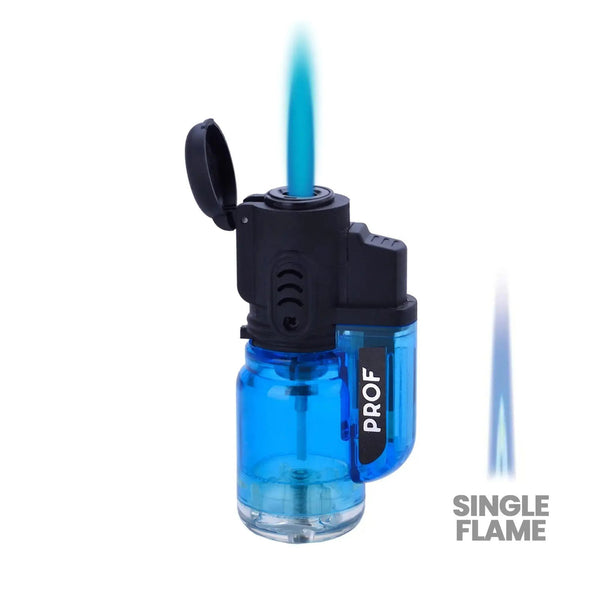
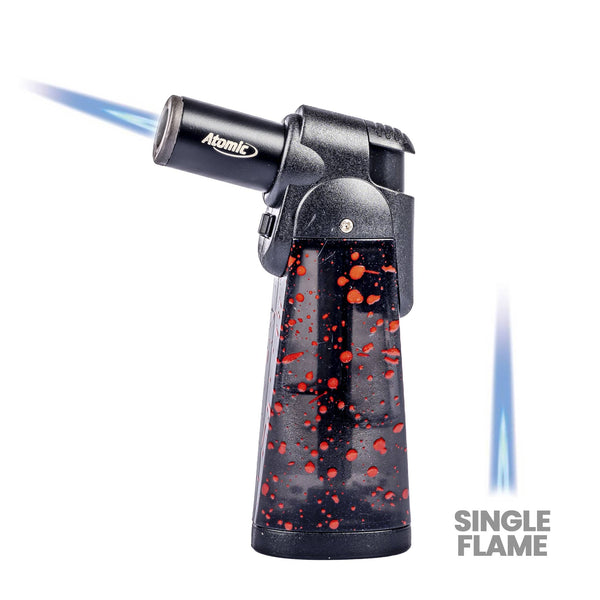
The Prof Jet scores 5.0 out of 7 reviews with us, which is remarkably high for a 4.95 euro model. If you're after something that disappears into a trouser pocket without you feeling it, the Atomic Jet is the compact alternative.
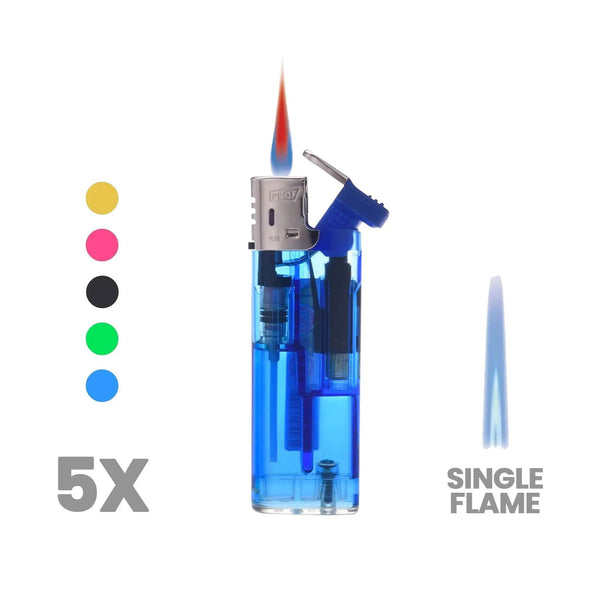
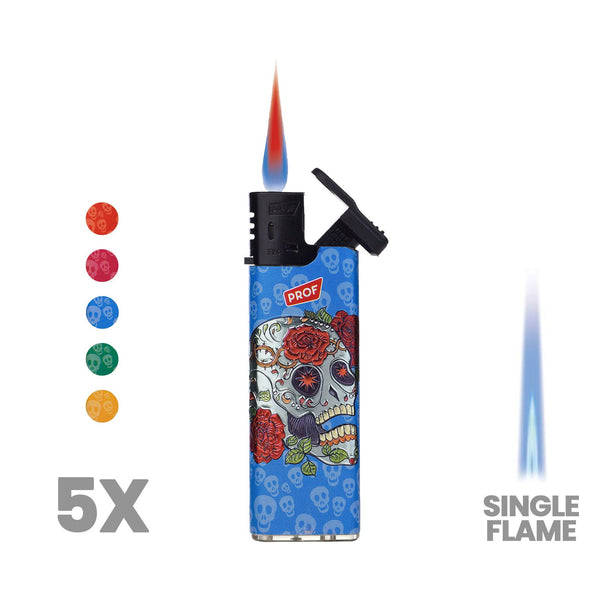
If you travel more often, a set is handier than a single one. The 5x Prof Slidecap comes with five for 7.95 euros, and the sliding cap over the top prevents exactly what a lighter in a bag suffers from: a button that gets pressed by itself and fluff creeping into the opening.
If you lose one on the way, there are still four at home. The same lighter with a skull print is the 5x Prof Slidecap 3D Skull.
All four work with a jet flame. That means all four stay at home when you fly: they're meant for where you're going, not for the journey there.
Lighter in hand baggage: what happens at security
Out of your bag, into your pocket
Many people search for "lighter in hand luggage" and picture the bag they carry into the cabin. That's exactly where it doesn't belong. Take your lighter out of your bag before you reach the scanner and put it in your trouser pocket.
At some airports, you're asked to place it in the tray; you'll simply get it back afterwards. If it's in your rucksack, a hand check almost always follows.
What happens if you forget
Security staff will take the lighter out and assess the type. A regular flame lighter is usually still allowed on your body. A jet model goes straight in the bin, however much of a shame that is.
That's exactly why you should leave your good refillable lighters at home before heading to the airport. Losing a lighter worth a couple of euros is annoying; losing a gift is worse.
Rules differ by country and airline
Different rules apply outside Europe
The international guideline is one thing, enforcement is another. In some countries you're not allowed to bring a lighter on board at all and must hand it in before the gate. In other places, no one even looks at it.
If you fly via a stopover, you'll also be subject to that country's rules, even while in transit. The strictest rule on your route determines what you can bring.
What's best to do
Assume the strictest scenario and don't bring anything you're attached to. You can buy a lighter almost anywhere in the world for small change. Unsure about a specific airline? Check their page on dangerous goods before you pack. It takes two minutes and saves discussion at the scanner.
What to look for in a lighter for travel
Refillable or not
A refillable lighter lasts for years and only costs you the odd can of gas now and then. That's not only cheaper, it also saves a stack of plastic. For home use, I'd always go refillable. For a flight, not so much, for the simple reason that you could lose it.
Cap or lock
A lighter loose in your trouser pocket can get pressed in by accident. A cap or a lock button prevents that. The PyroPen Turbo Lighter has a longer neck, which makes it pleasant for candles and the barbecue, keeping your hand further from the flame.
If you'd rather have something small in your pocket, take a look at the Champ Saber Mini Lighter in pocket size.
Flame and wind resistance
A jet flame doesn't blow out, and you'll notice that the moment you step outside. That's exactly why these models are so popular, and at the same time why they get confiscated at security. Save them for the moments they actually make a difference: outdoors, in the wind, with cold hands.
Frequently asked questions
Yes, one regular lighter per person, carried on your body. So in your trouser or coat pocket, not in a bag. Turbo and jet lighters fall outside this rule and are confiscated at most airports.
No, not in your hand luggage bag. The lighter must be carried on your body, not in the bag you bring into the cabin. So take it out before you reach the security check.
No. Lighters are banned in hold luggage because pressure and temperature changes in the hold pose a risk. If a lighter is found during the scan, your suitcase gets pulled aside and you'll face a delay.
No. Turbo, jet and blue flame lighters are on the banned list at almost every airport, even when empty. Leave them at home and buy a simple disposable lighter at your destination.
One per passenger. Multiple lighters aren't allowed, even if you split them between different pockets. The same restriction applies to matches: one small box of safety matches, carried on your body.
No, butane refills are banned in all luggage. Small gas canisters aren't allowed either. If you're taking a refillable lighter on your trip, you'll need to buy gas at your destination.
In short
One ordinary lighter may come on the plane, carried on your person. Not in your hand luggage bag, not in your suitcase, and never with a spare refill alongside. If you have a turbo or jet model, assume it stays at the scanner.
That is not bad luck but policy, and at every airport it can work out slightly differently. My advice is simple: leave your good lighter at home and pick it up again when you are back. If you are looking for one that waits there for you, have a calm look around our lighters.
Related articles
 Lighters
Which lighter is easiest for older people or arthritis?
 Lighters
Jet flame lighter or soft flame: what is the difference?
 Lighters
Lighter not working anymore? Find the cause
Want more articles like this?
New tips, product comparisons and exclusive offers straight to your inbox. Plus 10% off your first order.